
Here is the mistake people make with inari: they assume the triangular one is the Tokyo style. It is the opposite: the triangle is Osaka, cut to look like a fox’s ear, while Tokyo favours a plump oval. Inari sushi is the piece that surprises everyone: no raw fish, no nori, just seasoned rice tucked into a sweet fried tofu pouch. Once you know what it is, it becomes the order you reach for when you want something warm-tasting and honest.
What is Inari Sushi?
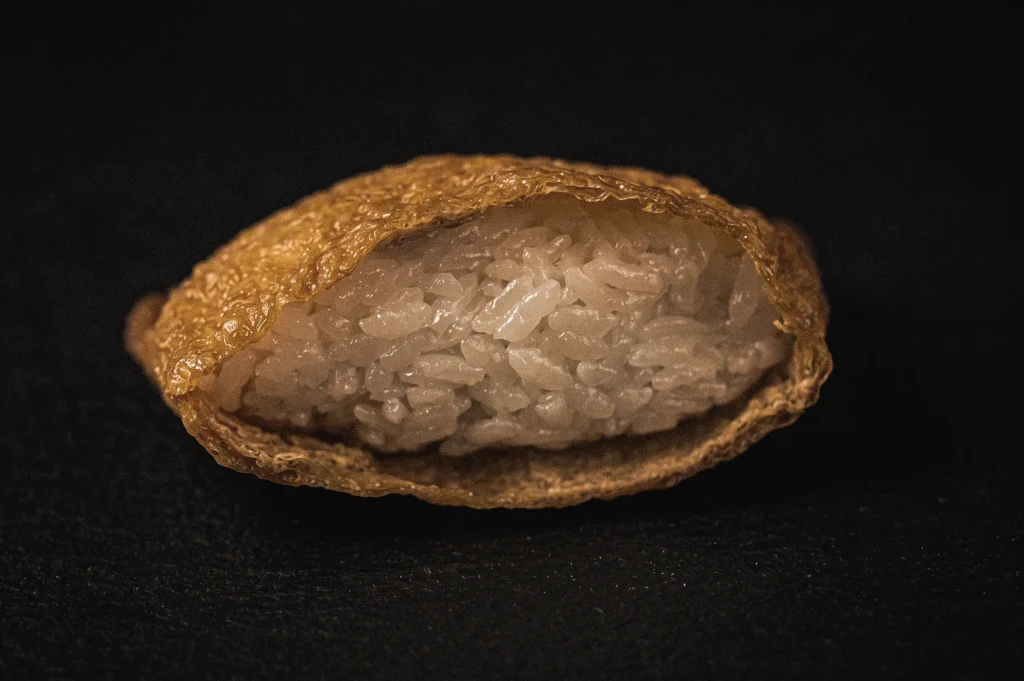
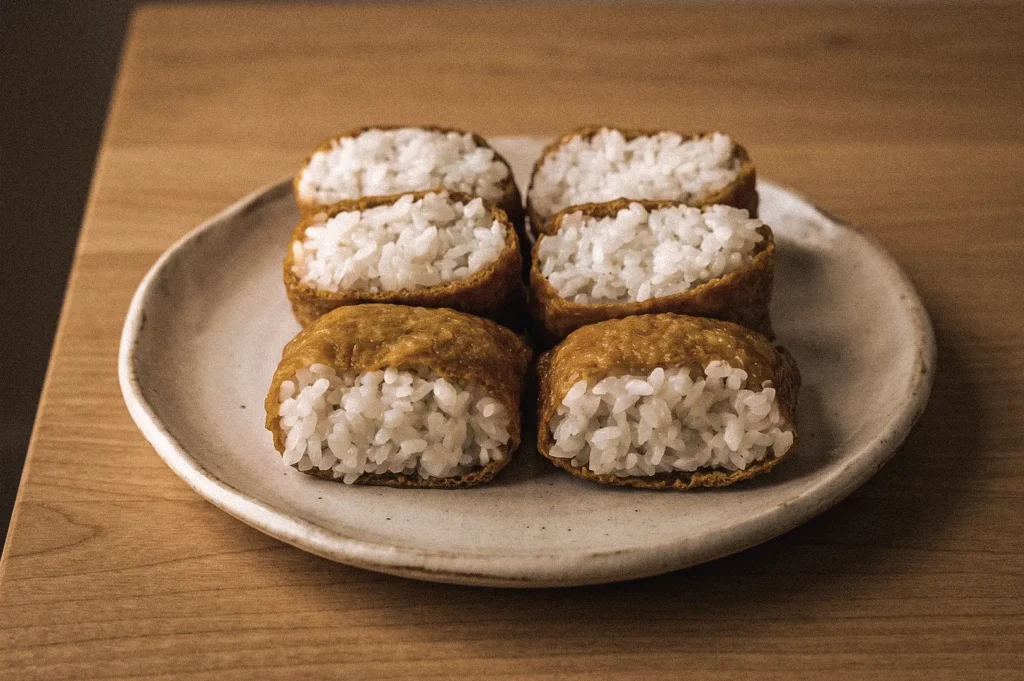
Inari sushi, or inarizushi, is vinegared sushi rice stuffed into a seasoned, deep-fried tofu pouch. The rice is sumeshi (short-grain rice seasoned with rice vinegar, sugar and salt) and the pouch does the rest of the work. There is no seaweed wrap and nothing raw anywhere in it.
That is the whole design. A sweet-savoury pouch on the outside, tangy rice on the inside, eaten in a bite or two. It is one of the most approachable things on a sushi menu, and it hides more craft than it lets on.
The Origin and Meaning of Inari Sushi
Inari sushi dates to the Edo period, from 1603 to 1868, when it was food for common people: an early Japanese version of fast food. It shows up in the late-Edo chronicle Morisada Manko, written around 1837 to 1853, and an 1852 woodblock book depicts street vendors selling it. By the end of the era, shops dedicated to it already existed.
The name comes from Inari Okami, the Shinto deity of rice, agriculture and prosperity. Fried tofu was offered at Inari shrines, and the dish took the deity’s name. There is a fox in the story too: kitsune, foxes, are said to be Inari’s messengers and to love fried tofu, which is why inari is also called kitsune-zushi, “fox sushi”; the same logic that names kitsune udon. You will also hear it called o-inari-san or aburaage-zushi, and the stuffed pouch is said to resemble a rice bale carried by Inari. Inari was the everyday street food of the same city that gave us the refined counter tradition; for that side of the story, see our guide to edomae sushi.
What is Inari Sushi Made of?
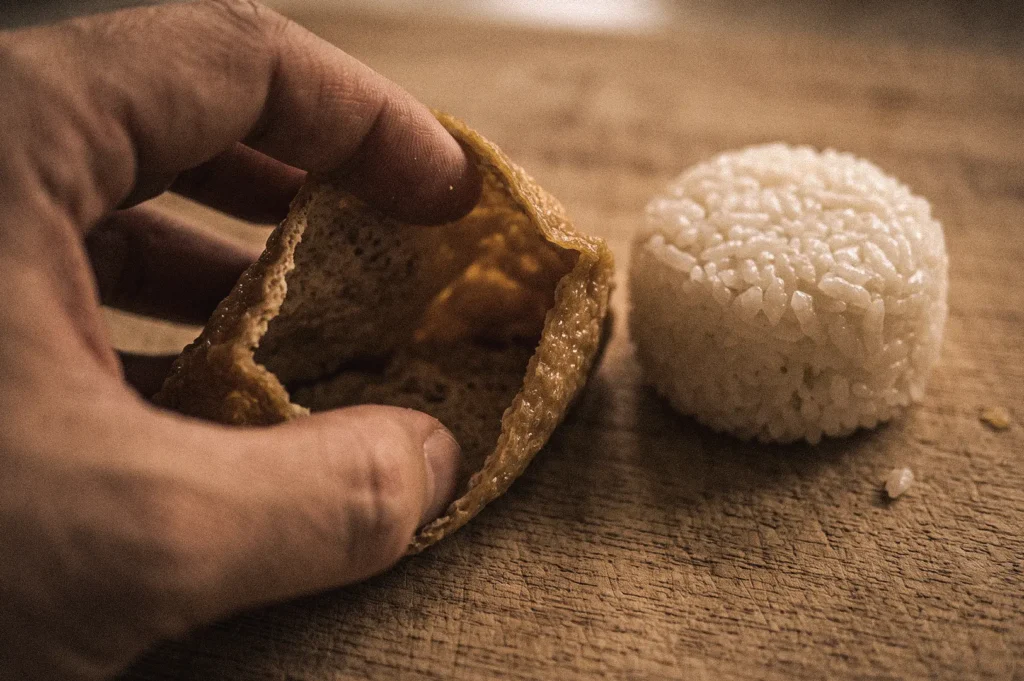
Two components, and both matter. The pouch starts as aburaagee: thin slices of firm tofu deep-fried, often twice, until they puff into hollow pockets. Simmered in seasoned broth, that aburaage becomes inari age, the sweet, juicy wrapper you actually eat.
The filling is simply the vinegared rice. Sometimes it is left plain, sometimes it carries mix-ins: toasted sesame, carrot, shiitake, hijiki seaweed, gobo burdock, bamboo shoots or a little pickled ume plum. The balance between the two halves is the point: a sweet pouch needs sharp rice underneath it, or the whole thing turns cloying.
How Inari Sushi is Made
The pouch is where the real work happens. Blanch the aburaage first to strip out excess frying oil, then simmer it in dashi (Japanese stock) with soy sauce, mirin and sugar under a drop lid until the broth soaks in. You cool it in the liquid and squeeze it gently, leaving it juicy rather than wrung dry.
That last step separates a good pouch from a dull one. Most places use mass-produced inari age, uniformly sweet and a bit flat. A careful kitchen simmers its own aburaage in dashi drawn fresh from quality kombu kelp and shaved katsuobushi bonito flakes, letting clean umami lead so the pouch needs less sugar, then under-squeezes it so it stays wet. The rice is seasoned to a precise vinegar-sugar-salt balance so its acidity cuts the pouch’s sweetness. Fiddly? Yes. It also makes the difference between a snack and something worth ordering twice.
Kanto vs. Kansai: The Two Styles of Inari Sushi
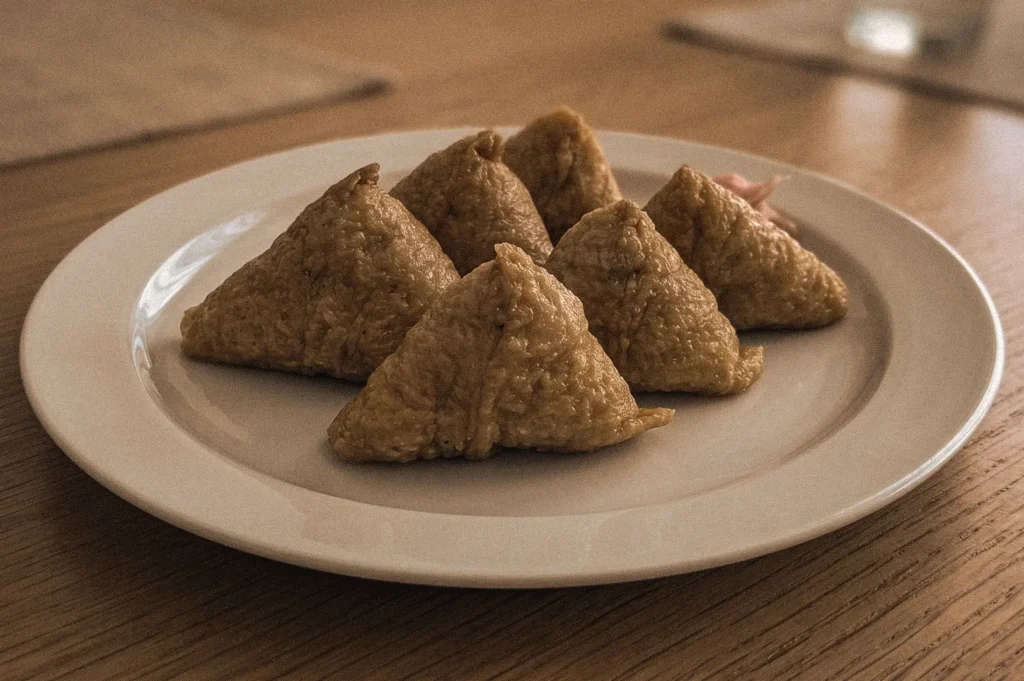
The regional split is easy to read once you know the shapes. Kanto, the Tokyo east, makes an oval or barrel shape like a rice bale, seasoned with dark koikuchi soy sauce, so it runs sweeter and saltier, usually with plain sushi rice inside.
Kansai, the Osaka and Kyoto west, cuts a triangle styled on a fox’s ear, uses light usukuchi soy sauce, and leans lighter and more dashi-forward, often with ingredients mixed into the rice. So if someone tells you the triangle is Tokyo, they have it backwards. Triangle is Kansai; oval is Kanto.
How to Eat Inari Sushi
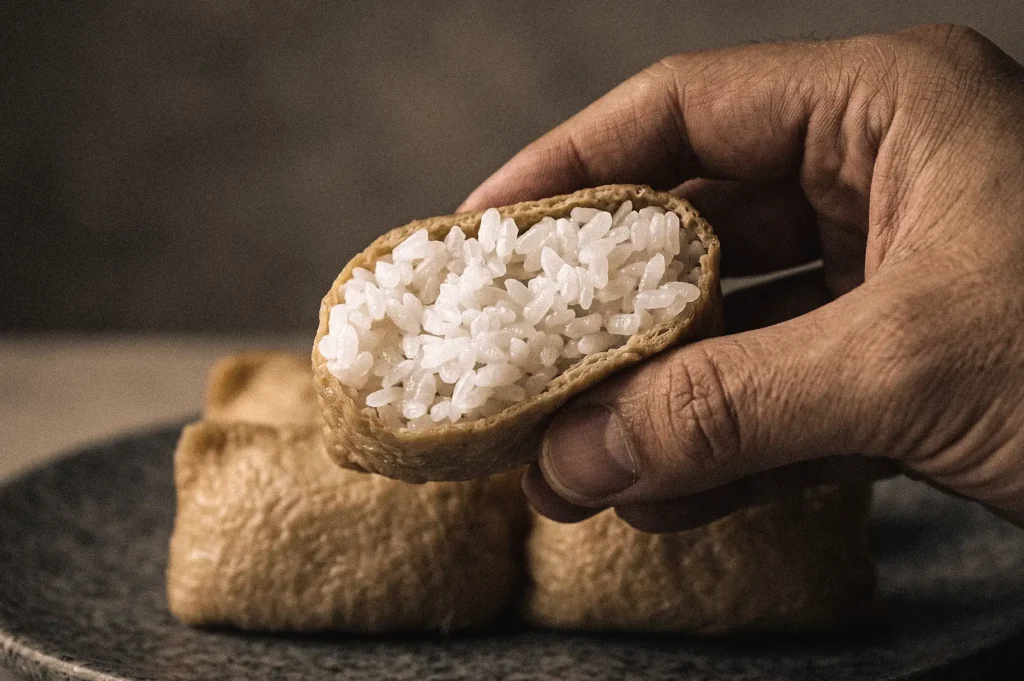
Eat it with your hands, at room temperature. The pouch is already seasoned, so it needs no soy sauce and no wasabi; a little gari, pickled ginger, or a shiso leaf alongside is plenty. This is the sushi that suits people who do not eat raw fish, and it travels well precisely because nothing in it is raw, which is why it is a fixture in bento boxes, at picnics and festivals, and popular with children.
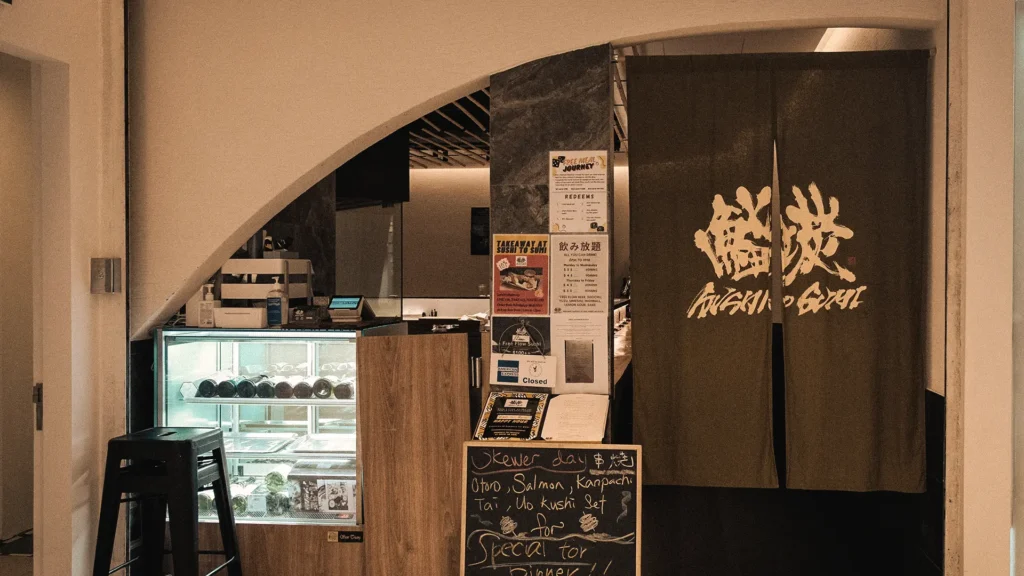
It is also worth eating a properly made one rather than a supermarket pack. A house-simmered pouch, dashi-led and only lightly sweetened, is a genuinely different thing from the uniform stuff sold in trays. If you want to taste that difference, try it at a sushi bar in Singapore that simmers its own aburaage; Sushi to Sumi is a standing sushi bar and charcoal-grilled seafood counter at 20 Cecil St, backed by Araya Shoten, a Japanese fishmonger with sourcing lines reaching beyond Tokyo’s Toyosu Market up to Hokkaido, with a menu that changes daily. Lunch runs 30 to 45 minutes if you are eating on a work break.
Inari Sushi FAQ
Is inari sushi vegan? Only sometimes. There is no raw fish, but most shop-bought inari age is simmered in bonito dashi, which is fish-based. It is genuinely vegan only when the pouch is simmered in kombu (or kombu-shiitake) dashi instead. Ask before you assume.
Is inari sushi served hot or cold? Room temperature. It is not meant to be hot, and chilling it hard dulls both the rice and the pouch. Straight from a cool room, eaten by hand, is right.
Is inari sushi gluten-free? Not reliably. Standard soy sauce contains wheat, so unless the kitchen uses tamari, treat it as containing gluten. The main allergen either way is soy. Reckon on roughly 80 to 100 kcal per piece: carb-forward, with some added sugar and soy-sauce sodium.
Inari sushi proves the point that sushi is about the vinegared rice, not the fish; it is a long-established, legitimate sushi type with nothing raw in it at all. If you’d rather taste the difference than read about it, we’re at 20 Cecil St, one floor up. Book a spot at the bar.